If you’re trying to figure out how to self-publish a children’s book for the first time, this is not a step-by-step guide. It’s what worked, what didn’t, and what I learned while figuring it out myself.
How do you self-publish a children’s book when you have absolutely no idea where to start? That’s an excellent question and one that I am seriously unqualified to answer.
Here’s the thing though, my books are printed and are waiting to be shipped to me, and I’m still not sure I know where to start. I just know that I did start and slowly but surely made my way from scribbles in a little spiral notebook to 3,000 actual books. And that has to count for something.
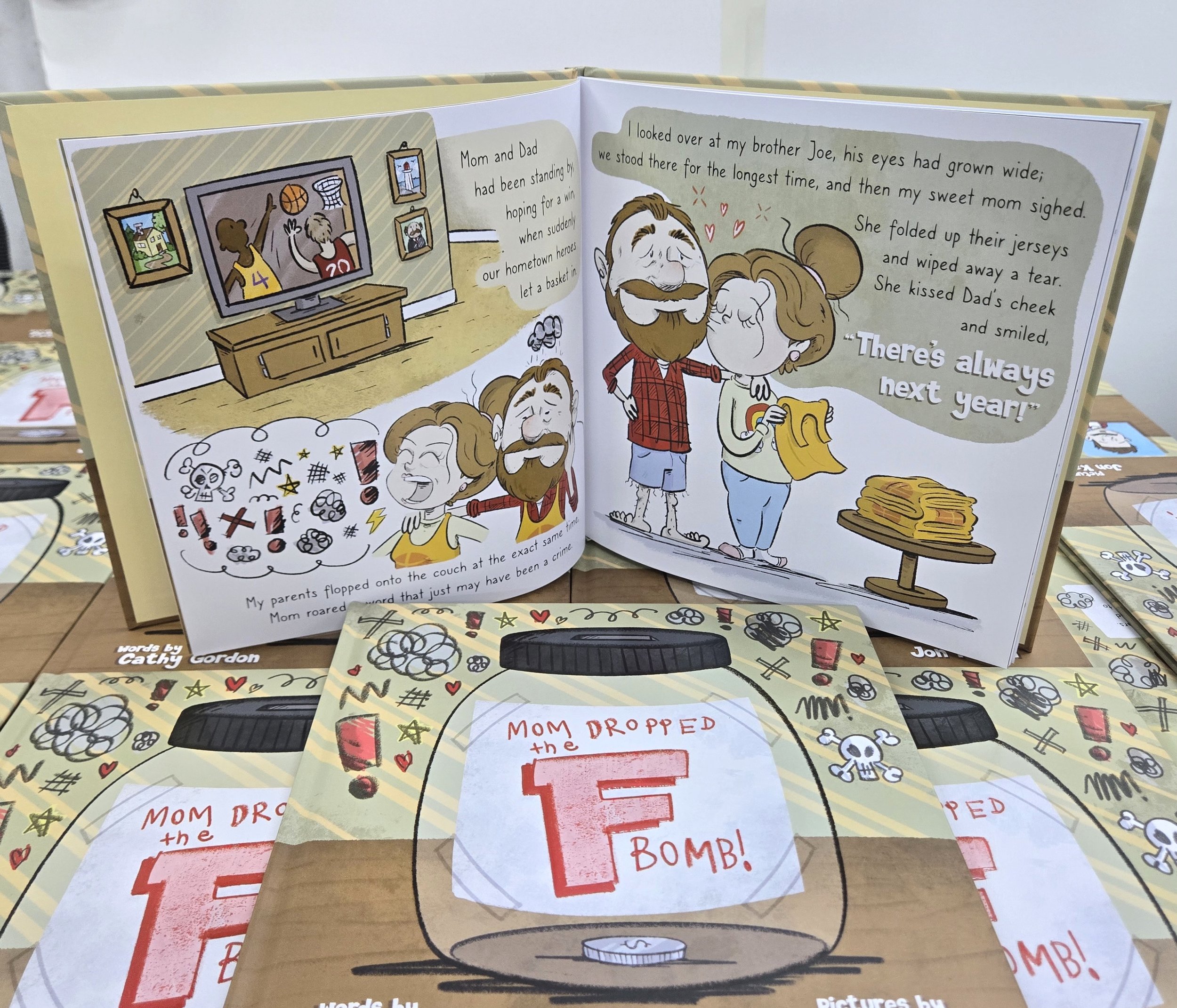
It Started With a Very Annoyed Woman in a Bookstore
It all began around 2020 when I was working at Indigo in Milton, Ontario. A customer became extremely upset about a display of Mark Manson’s bestselling book The Subtle Art of Not Giving a F*ck. The word was censored on the cover, but she was furious that her young daughter had now been exposed to the F-word for the first time.
She berated the staff and demanded the display be removed. She was very concerned that she was now going to have to explain this word to her child. We were not going to remove a bestselling book from the front of the store. We told her that. She was not pleased.
As I walked away from that conversation, I snickered to myself while thinking about how different her experience of parenting was from mine. I pulled the little notebook I carried out of my pocket and started writing a rhyme that had popped into my head. The words just poured out onto the page, and in no time at all, it was good. It was really good!
Over the next couple of days, I played with it. I moved things around. I wrote down more phrases. A few of my bookstore friends read it and said things like, “You might actually have something here.”
And then I put it away. For about three years. So tip #1 - write something great and then lose it in your crawlspace for 3 years; as it turns out, that is one way to start self-publishing a children’s book. (DO NOT DO THIS! IF YOU KNOW YOU HAVE SOMETHING GREAT, MAKE SOME MAGIC HAPPEN!)
Just Start It Again
A few years later, I was working with a fantastic coach, Mitchell Creasey of The President’s Coach. We were technically talking about my photography business when I casually mentioned this book I had started. He stopped me. “I think this is why we’re here.”
It turns out, it was. One small hitch though, I had absolutely no idea where the manuscript was.
To summarize his answer to my big problem, he said, “it doesn’t matter. Start it again. You’ll find the original when you’re finished.” So I started again. And yes, once I had a completed manuscript in my hands, I found the original notebook in a box in my crawlspace. He was right.
One happy point for me was that quite a few of those original lines had found their way into the new version almost exactly as I had first written them. I saw that as a real sign - this was what I was meant to write.
Learn the Rules. Figure Out Which Ones You’re Going to Break.
I’ve loved to write for as long as I can remember. I’ve always kept journals, jotted down my thoughts here and there. I’ve always seen it as a skillset, and for reasons unbeknownst to me, I never pursued it further until I had this story in my hand.
So, I knew that I could write. I also knew that I knew NOTHING about writing a kids’ book. Quality books have always been one of my life’s joys, so if I was going to do this, I felt strongly that I had to do it right.
I looked for courses on writing for children and decided to sign up for Miriam Laundry’s Children’s Book Masterclass I worked on the manuscript as I navigated the course. It was truly invaluable. I learned about story structure, character development, finding an illustrator, publishing, marketing and so much more.
Truthfully, I also ignored some of the advice. For example, the course advised against writing in rhyme, because rhyme is really hard to do well. The thing is, I knew I could rhyme well and I knew this story worked in rhyme. Like, really worked. So I kept it.
Here’s the biggest rule that I chose to break, “make sure your subject matter is age appropriate.” Here I was, quietly sitting there writing a book called Mom Dropped the F-Bomb. I still don’t think I ever shared that with the group, and who knows? Maybe today is the day.
For the record, there is no cursing anywhere in the book. The subject may seem a little spicy, but the book itself is absolutely appropriate for all ages.
That course taught me an enormous amount about writing a book for kids. I took away an extra valuable lesson. That is, learn as much as you can from people who know what they are doing with the understanding that your particular book may require you to bend some of the rules. Happily, I’m fairly comfortable bending rules.
The Moment I Thought, F*ck, This Might Actually Work
Eventually, I needed someone professional to look at the manuscript.
I specifically looked outside the masterclass program I had taken because I was still nervous about how the subject matter would be received. I sent the manuscript to editor Jennifer Rees and waited. I was terrified. Imagine my overwhelming joy when she back with an absolutely glowing response.
There were suggested tweaks and changes, of course. There will always be changes; it’s very difficult not to take these personally. I learned quickly not to fall so in love with the first manuscript that it’s impossible to let anything go. Sometimes a line you adore needs to leave because the book is better without it. Trust me, that can hurt a little.
Reading Jennifer’s response was the first time I really thought, f*ck, this might actually work.
Then I Queried. And Queried. And Queried Again.
Before choosing self-publishing, I tried the traditional route. I queried agents. So, so many agents.
Most queries disappear into the void, which I learned is fairly normal. But I did get responses, and the feedback was often surprisingly consistent.
The book was funny. The rhyme was strong. The concept was interesting. But then came some version of: “I just don’t know where I would put this.”
Which was exactly the problem my editor had warned me about. But I could not disagree more! It is a children’s picture book. It is absolutely safe to read to children. But it is also about a mom who says the F-word. That creates a slightly unusual marketing problem.
What bothered me was that the reaction from actual consumers was almost always completely different from the agents’ responses. When I told moms about it, I heard things like: “Oh my God, I need that” or “I would buy that for my friend” also, “That would be a perfect baby shower gift” and my favourite, “That is my mother.”
That is why I never stopped believing there was an audience for it. The agents just did not necessarily know how they were going to sell the concept to a publisher.
And then…one morning in February 2026, I woke up and thought, “I’m doing this myself.” That was it. No dramatic turning point. No rejection fueled breakdown. I just decided. And that was that.
So... How Do You Actually Self-Publish a Children’s Book?
Remember when I said I knew nothing about writing a book? I knew even less about self publishing. This is where things became very Google-heavy. I Googled everything. I watched hours of YouTube videos. I joined author groups. I found Facebook groups for self-publishers. I asked questions. (A lot of questions.)
And I did something that ended up being one of the most useful things in the entire process. I looked at companies that offer complete self-publishing packages. Not because I wanted to hire them, I wanted to know exactly what they did, I wanted their lists of services.
I figured if these companies were offering authors editing, illustration, formatting, ISBN help, printing assistance, distribution and everything else, then their service list was essentially a list of everything I needed to either learn how to do or hire somebody else to do.
That gave me a roadmap. Not the roadmap. My roadmap. Many of those services required the skills I had built over years of owning a photography business, of designing branding assets for clients, of formatting files and marketing pieces.
And strangely enough, those website creeping sessions led to me finding my illustrator. I was clicking through illustrators listed on one of those sites when I found Jon Kalvin. I opened his website and knew immediately. That’s him, that’s exactly who I need. I contacted him. He liked the project. When those first sketches arrived, the characters I had been carrying around in my head were staring back at me. That was one of the strangest and best parts of this entire experience.
My little spiral notepad that had become a Word document was becoming a book.
And Then I Learned About Printing
This was easily my steepest learning curve. Being a photographer helped enormously with the technical file side. File sizes, dimensions, resolution, bleed and preparing things for print were all concepts I already understood.
Printing books was another story. I knew fairly early that I did not want to use print on demand. I had heard enough stories about inconsistent quality that I wanted more control over the finished product. If someone bought my book, I wanted them to receive the same beautiful book as everyone else who ordered it.
I started getting quotes. Eventually, the numbers made something fairly obvious. If I wanted to produce the book I wanted and still price it at an amount an average family would reasonably pay for a picture book, I needed to look at overseas printing. That was a tough one for me. But my end goal was always to put this book into as many hands as possible. My fellow imperfect moms need this book!
I had to learn a completely new vocabulary. Offset printing. DDP. Importing. Freight. Customs. Shipping. These are a far cry from all of the glamorous things you picture when you first think, “Maybe I’ll write a children’s book.”
I asked people who knew things. A friend who works in logistics explained importing to me. Other authors told me about their printers. I asked questions in groups. I learned that authors LOVE to help other authors.
Then I asked more questions. That has probably been the most useful skill I have brought to this entire project. I am not afraid to say, “I don’t know what that means.”
I Have F’d Up Along the Way
My sell sheets were too big. They looked great but they cost way too much to mail. Lesson learned.
I announced pre-orders long before I really had my pre-order timeline sorted out. I had to announce a delay and learn how to properly host a pre-order. Lesson learned.
I spent quite a while having no firm idea when pre-orders would actually end. I do now. Lesson learned.
There have been lots of little moments like that. Something doesn’t work. Okay, onto the next thing. I think that has been an important change in the way I look at mistakes through this project. I am either right, or I am learning what would have been right, or at least, more right? There is going to be some of that when you are doing something you have never done before.
I did the numbers. My break-even point was somewhere around 1,500 copies. But I don’t want to simply break even. If I want to make book two, there has to be enough left to actually fund the project. SO I ordered with profit in mind. That is difficult to me, but here we are, I have ordered 3,000 copies.
That is exciting and slightly insane. And I ordered them without somewhere to put them. GULP. Don’t worry, that has been remedied!
What I’m Glad I Did
I’m glad I did not let “I don’t know how to do this” become a reason not to do it. There were plenty of times when I thought: “I don’t know anything about publishing.” or “How am I supposed to do this?”
I would remind myself that every successful self-published author before me was not born understanding ISBNs and freight logistics. They learned that shit, and I would too. So I kept going.
I hired professionals where I felt professionals mattered. I paid for good editing. I hired the illustrator I wanted. I asked questions when something was beyond my knowledge. And I did the things I knew I could do myself. That combination worked for me and I realize that it may not work for somebody else. And that is kind of the point. This is not a “one size fits all” type of industry, you can make it what works for you.
And Now There Are Actual Books. Actual F’ng Books.
As I write this, Mom Dropped the F-Bomb is printed and waiting to ship. I saw photos and video from the printer and had a bit of a tearful moment because suddenly there it was. An actual fucking book.
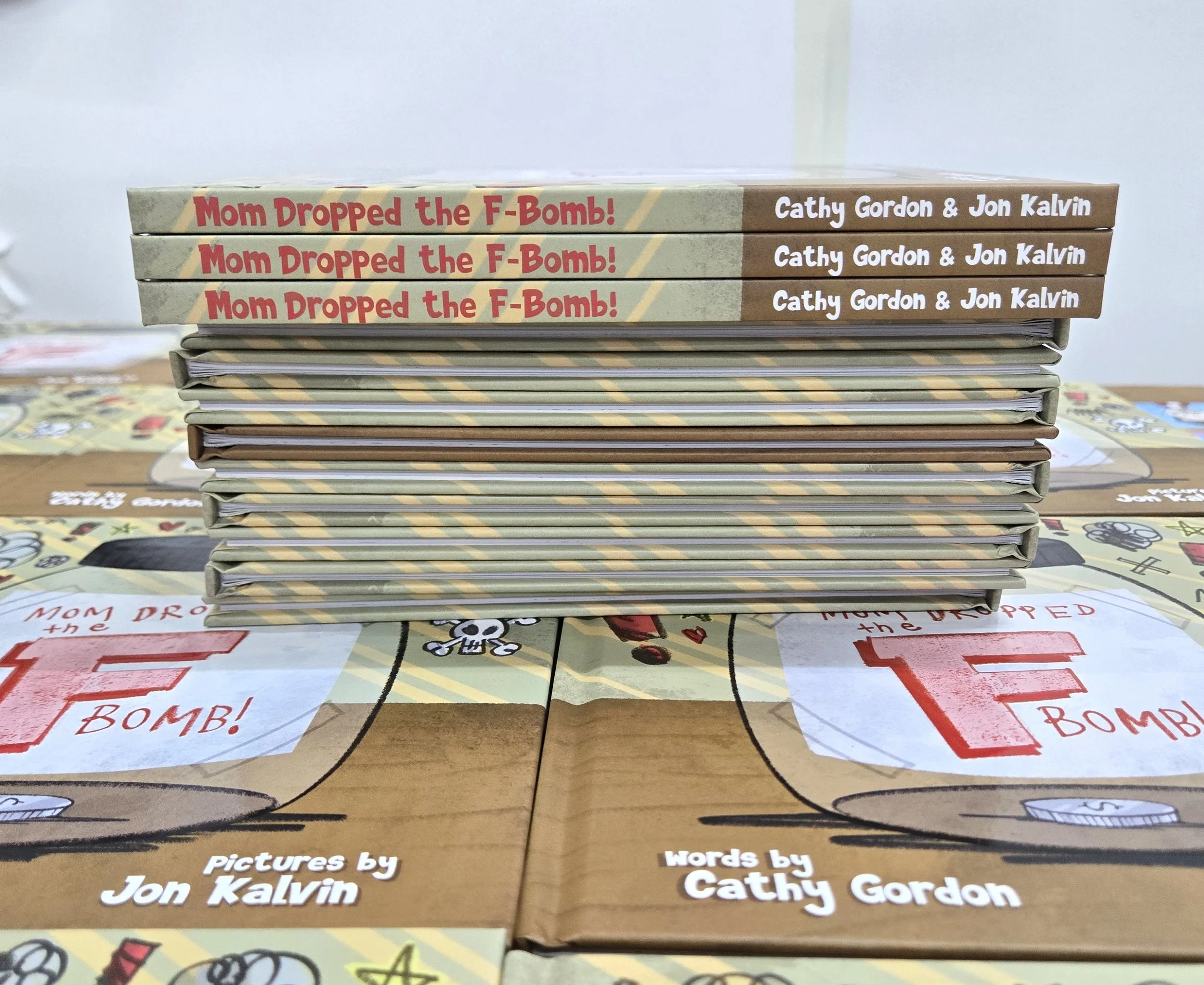
I’m excited, and relieved, and scared, and incredibly impatient to hold one in my hands.
I still have no idea what I’m doing with some of the distribution.
I am working hard to get sell sheets into the right hands, connect with bookstores, sort out retail opportunities and figure out the next part of this adventure. I’m basically facing it with a deep breath and a willingness to figure out whatever comes next.
Which is pretty much how I got here.
So Where Do You Start? My Best Tips!
If you want to self-publish a children’s book and have absolutely no idea where to start, I would tell you this:
Follow the questions that pop into your head.
When you think, “How do I find an illustrator?” Look it up. When you wonder, “How do ISBNs work?” Look it up.
When somebody mentions DDP and you have absolutely no idea what they are talking about, ask. Write the answers down. Be curious about every step.
Look at what professional self-publishing companies do and use their services as a clue to what needs to get done.
Most importantly, tell people about your book. Tell everybody. Imagine that every person you tell knows something you don’t.
Someone knows a printer, someone understands logistics, someone knows a bookstore owner. Someone has self-published before. Someone knows an illustrator.
And sometimes somebody simply says, “I think this is why we’re here.”
So start. Even if you still have no idea what you’re doing. Because eventually, they print the books anyway. And you still won’t really know.
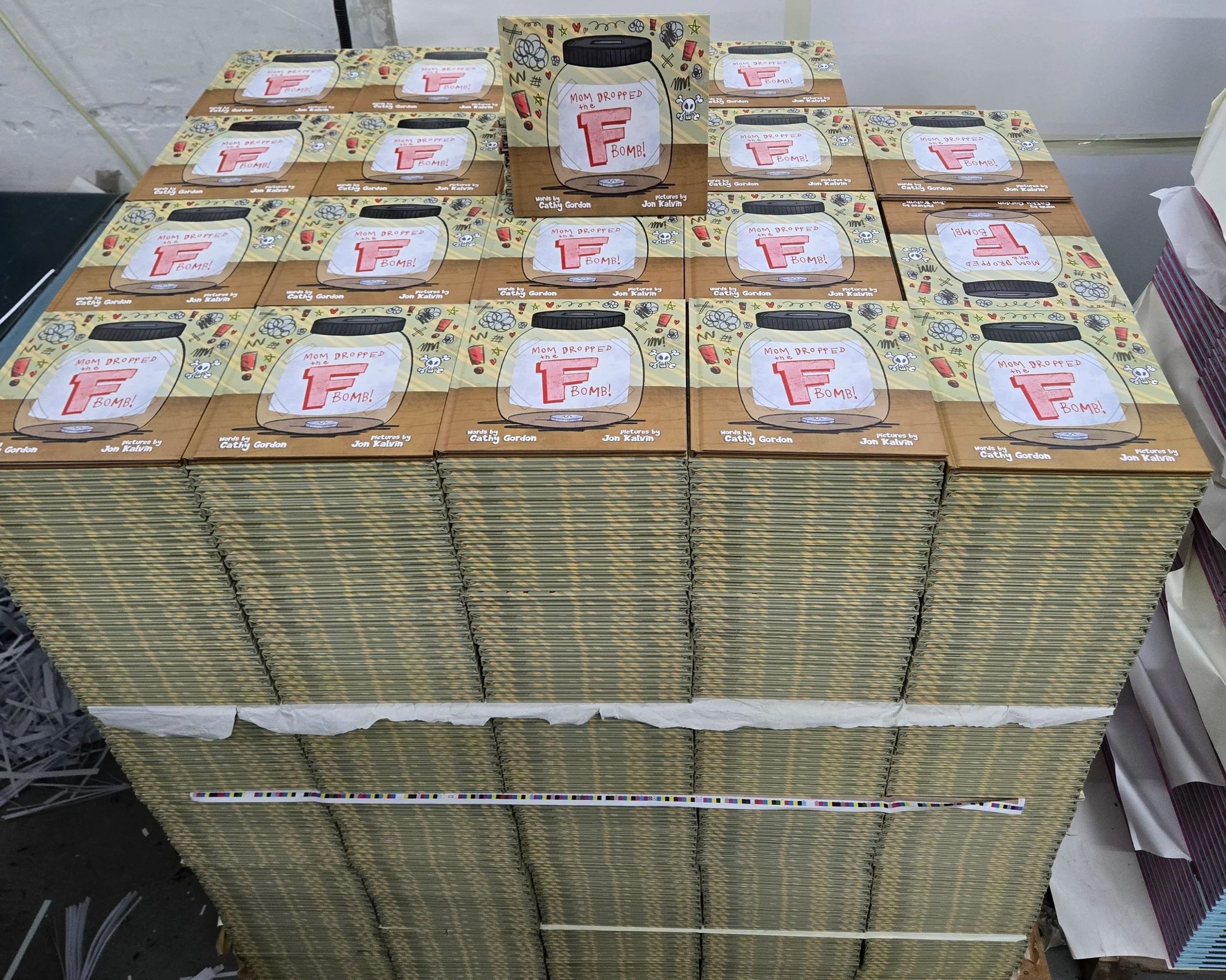
Want to follow what happens when those 3,000 books actually arrive? Join The F-Bomb Files for publishing updates, behind-the-scenes stories and launch news from Mom Dropped the F-Bomb.